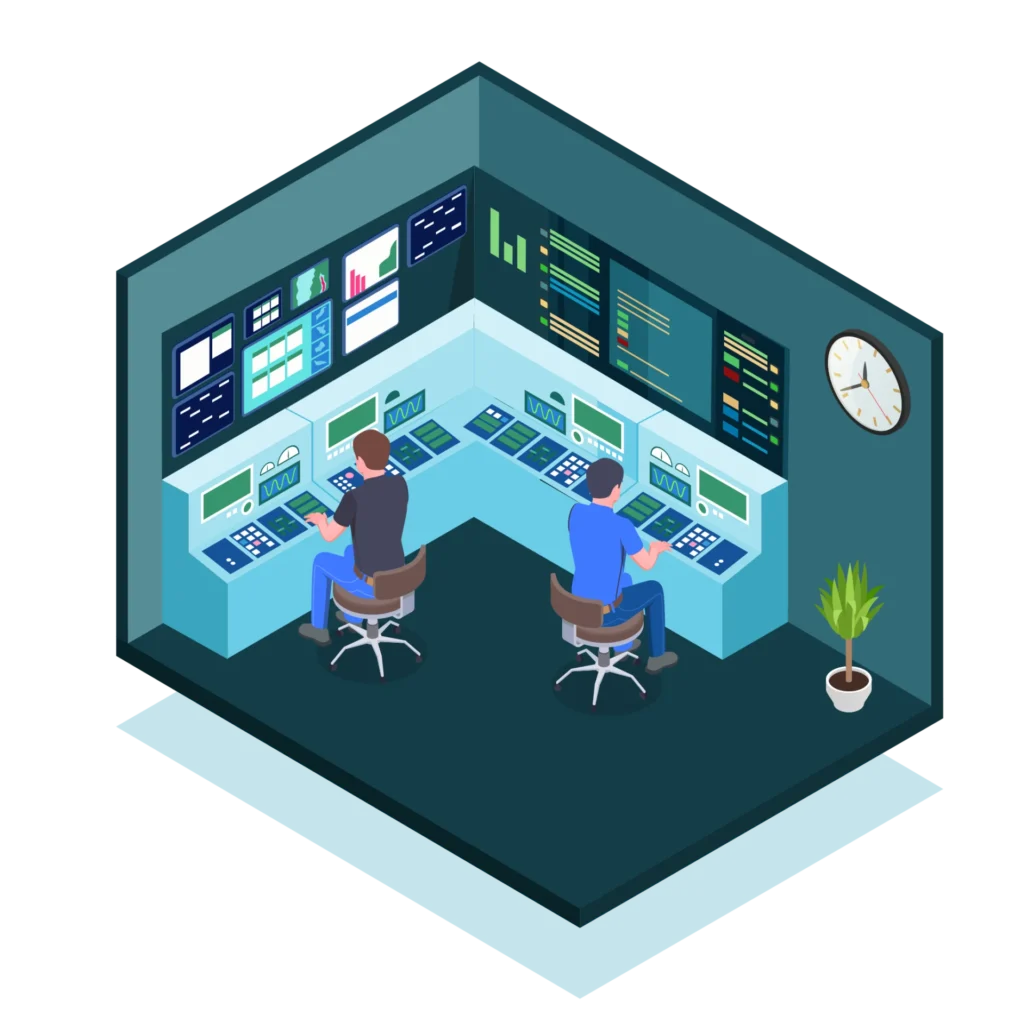
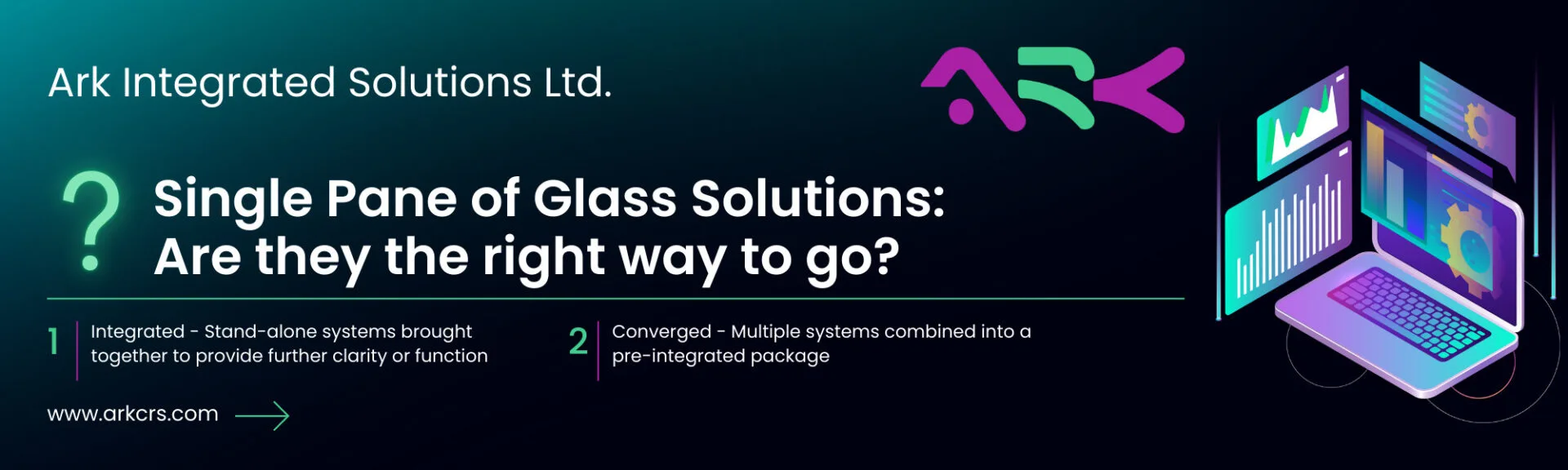
Building automation has evolved from isolated mechanical controls to intelligent, data-driven environments that support operational efficiency, occupant comfort, sustainability, and security. Two key architectural approaches dominate modern building technology discussions: integrated systems and converged systems. While these terms are sometimes used interchangeably, they represent distinct philosophies in how building technologies are designed, connected, and managed.
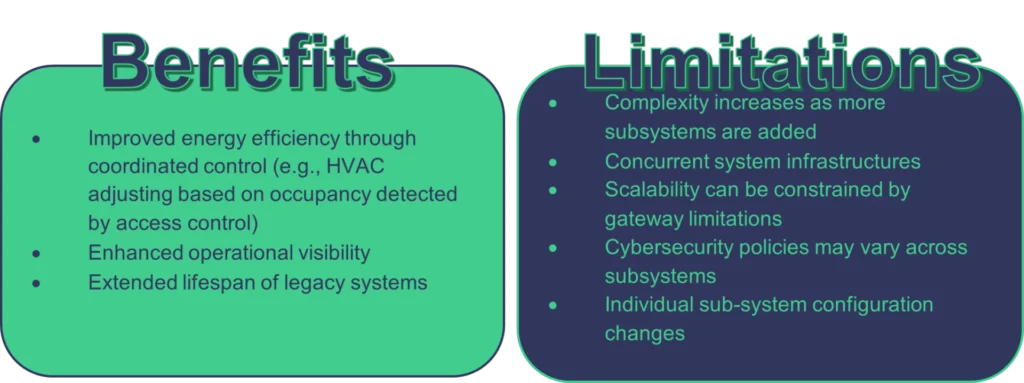
An integrated building system refers to the coordination of traditionally separate building subsystems—such as HVAC (heating, ventilation, and air conditioning), lighting, fire alarms, access control, elevators, and energy management—through interoperability at the application or supervisory level.
Historically, systems operated independently using proprietary protocols. Integration emerged as a way to connect these systems through gateways, middleware platforms, or open communication standards such as BACnet or Modbus. The result is a centralised Building Management System (BMS) that aggregates data and allows coordinated control strategies.
In essence, integrated systems create collaboration between distinct building technologies while maintaining structural separation at the infrastructure level.
A converged building system goes further by unifying building technologies onto a shared infrastructure. Rather than connecting systems after deployment, convergence designs them from the outset to operate over a common digital backbone.
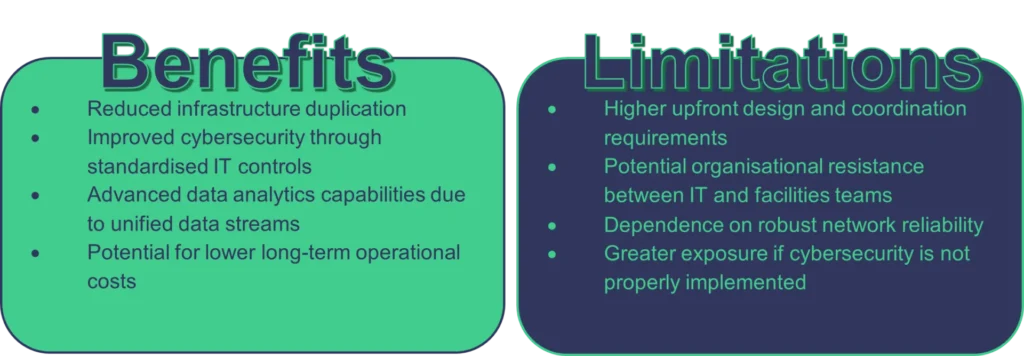
Convergence is not simply about connectivity—it represents a shift toward buildings functioning as digital platforms.
Integrated systems focus on operational collaboration, whereas converged systems emphasise infrastructural unification.
When deciding between integrated and converged approaches, building owners must consider lifecycle costs, risk tolerance, organisational structure, and long-term digital strategy.
For retrofit projects, integration is often more practical. Existing buildings with legacy systems can benefit from supervisory integration platforms without replacing core infrastructure.
In contrast, new construction projects—especially smart campuses, hospitals, and commercial high-rises—may benefit more from convergence. A converged approach supports emerging technologies such as AI-driven predictive maintenance, digital twins, occupancy analytics, and IoT sensor networks. It is important to consider the implications should a converged system break down or have a fault. Leaving an operator with no access to vital information and controls can have significant risk and cost to the facility and its occupants.
Cybersecurity is a defining factor between the two models. Integrated environments often suffer from inconsistent security postures because each subsystem may have different firmware standards and patching schedules. Converged environments, by contrast, fall under enterprise IT security policies, benefiting from centralised monitoring, firewalls, segmentation, and identity management.
However, convergence also increases the importance of secure architecture design. A vulnerability in one device could potentially impact the entire network if segmentation is poorly implemented.
The industry trend increasingly favours convergence as buildings become more digitised and data driven. Smart building certifications, sustainability mandates, and occupant experience technologies demand seamless data exchange and advanced analytics.
Nevertheless, integration remains highly relevant, especially in the vast stock of existing buildings worldwide. In practice, many facilities operate in a hybrid state—integrated at the software level while gradually transitioning toward converged IP infrastructures.
Integrated and converged systems represent different stages in the evolution of building automation. Integration connects systems that were designed separately, enabling coordinated operation while preserving independent infrastructures. Convergence unifies systems from the ground up on a shared digital backbone, enabling scalability, advanced analytics, and tighter cybersecurity governance.
The choice between them depends on project scope, budget, organisational readiness, and long-term strategy. As buildings increasingly function as intelligent ecosystems, convergence is gaining momentum—but integration remains a powerful and practical solution for many real-world environments.
Ultimately, both approaches aim to achieve the same goal: smarter, more efficient, and more responsive buildings.